How to Care for Canvas Art in Salt Air and Sunlight
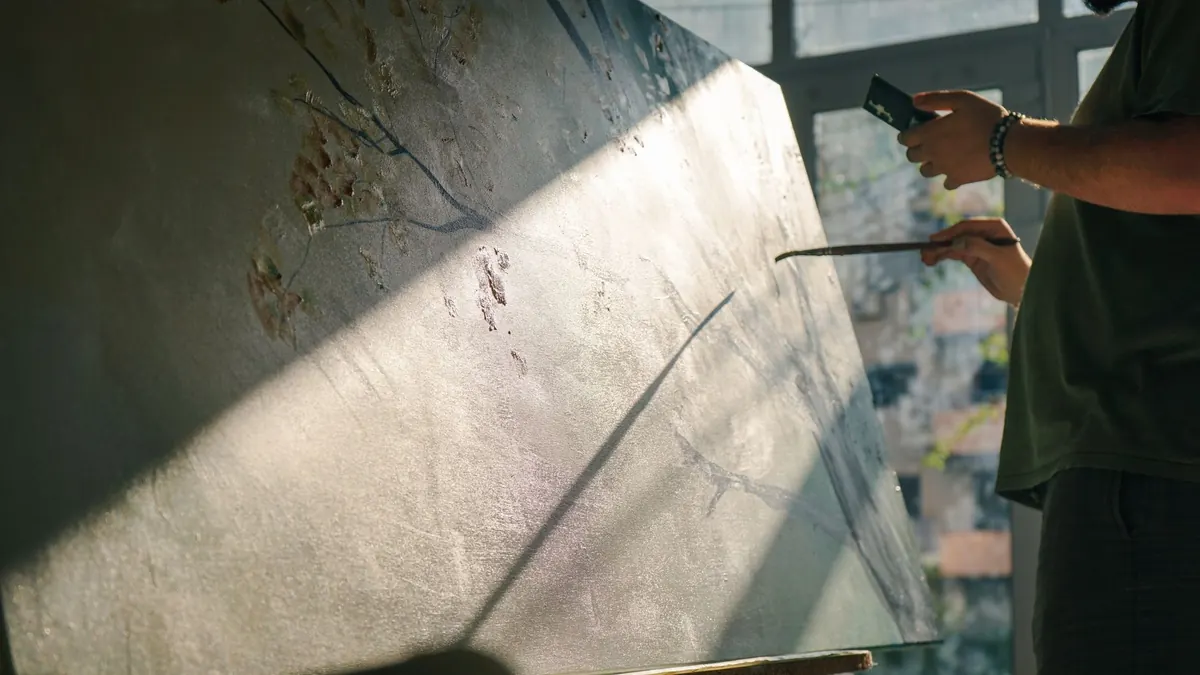
Canvas is a stubborn, forgiving material until it isn't. A painting that lives a few hundred metres from the water is asked to survive something an inland picture never faces: air that carries salt, light that arrives unfiltered off the sea, and humidity that swings with the weather. None of this ruins a canvas overnight. It works slowly — a faint bloom on the surface, colours that look a shade flatter than you remember, a stretcher that begins to warp at one corner. The habits below are the ones that make a real difference.
Salt and Sun: What Actually Damages a Canvas
Two things are doing the damage, and they behave differently.
Salt arrives as invisible aerosol and settles on everything. Salt crystals are hygroscopic: they pull moisture out of the air and hold it against the paint film. Left long enough, that shows up as a dull haze, pale tide marks along the surface, or a whitish bloom on varnish. Salt also attacks the metal in the frame and the hanging hardware, and it feeds mould in rooms where the air stays damp. The sea air you love on your face is, on a painted surface, an extremely slow abrasive.
Sunlight is the more permanent problem. Ultraviolet light breaks down the pigments themselves — blues and reds tend to shift first, which is why a faded coastal painting often looks oddly yellow. UV also yellows varnish and makes the canvas fibres brittle over decades. And plain heat matters: a canvas in direct sun expands and contracts against its stretcher, which is how you get slack corners and hairline cracks running along the stretcher edges.
Placement: Finding the Right Wall in a Coastal Home
Where a piece hangs decides most of its fate. Get this right and maintenance becomes almost trivial.
Choose ambient light, not direct sun
The ideal wall receives no direct sunlight but plenty of daylight — a corridor, an interior partition, the wall beside a window rather than opposite it. On an island, remember that reflected light off water and whitewashed exteriors is intense even where the sun never lands directly. If the only good wall takes a bright afternoon hit, fit a linen blind or an external shutter and use it.
Avoid the walls that sweat
In older stone and masonry houses, exterior walls stay cooler than the room. In humid weather, moisture condenses on them, and a canvas hung flat against one will sit in that damp film. Hang on an interior wall where you can, and if you can't, keep the frame off the surface with small felt or cork bumpers so air can move behind it. Keep canvases away from radiators, wood stoves, kitchen steam and bathrooms. Hang at eye level — centre of the piece at roughly 150 cm — and use two fixing points rather than one, rated for several times the weight. A canvas that falls is a canvas that needs restoration.
How to Clean a Canvas Without Doing Harm
Most canvas cleaning is dusting, done patiently and dry. Anything wet is a job for a conservator.
- Support the canvas. Slide a rigid board behind the stretcher, or have someone hold the back, so you never press the paint film from the front.
- Dust with a soft brush first. A wide, soft brush — the sort sold for calligraphy or make-up — lifted gently from top to bottom, is ideal. Never rub, and skip feather dusters; the barbs snag.
- Vacuum only through a screen. Use the brush attachment on the lowest suction, with a piece of fine mesh or a clean nylon stocking stretched over the nozzle. Keep the nozzle a centimetre off the surface. This is the best way to lift salt and grit out of the weave.
- Wipe nothing wet. No damp cloth, no glass cleaner, no vinegar, no baby wipes, no alcohol. Water carries salt into the weave and can leave a tideline; solvents can lift paint and varnish.
- Attend to the back. Dust the stretcher bars and check for woodworm and insect frass, which are common in old island homes. Look also at the hanging wire and screws — replace rusted hardware with stainless steel or brass before it fails.
- Stop if you see trouble. Flaking paint, mould that returns after dry brushing, a smell of damp, or a soft, pulpy canvas edge all mean professional help. Ask a paintings conservator before touching it further; a bad intervention costs far more to undo than the original treatment.
Protective Coatings: Helpful, but Not a Shortcut
A removable varnish is genuine protection — it seals the paint from airborne salt and slows the yellowing of the surface. It also gives future conservators something to remove instead of the paint. The catch is that varnish is only safe on the right surface, applied the right way.
Never varnish a canvas that may be damp or has ever shown mould, and never varnish an unknown painting yourself. Applying a solvent-based varnish over an old, unvarnished surface can darken it permanently or make earlier retouching swell and lift. Spray fixative and hairspray are not varnishes; they yellow, they can't be removed cleanly, and they are the single most common well-intentioned mistake.
If a painting matters to you and hangs in a salt-exposed room, the sensible route is to have a conservator assess it and, if appropriate, apply a thin coat of a removable varnish. Keep it to roughly once every decade or two, not annually. Acrylic paintings should not get an oil-resin varnish.
Frames, Backboards and the Glazing Question
Stretched canvas needs to breathe, which is why it is traditionally not glazed. In a very exposed house, though, a sealed frame with glazing held off the surface by a spacer can be a reasonable defence against salt spray and dust — provided the seal is genuinely good. A badly sealed frame traps humid air against the paint, which is worse than no glass at all.
What is almost always worth doing is a rigid backboard: archival foam board or corrugated plastic cut to the frame opening and taped over the reverse. It keeps out dust, insects and salt-laden air, and it is invisible once the picture is on the wall. Skip acidic cardboard, which off-gasses over time.
A Seasonal Routine That Takes Twenty Minutes
- Monthly: dry-dust the front and back with a soft brush. In windy months, do it after the weather clears.
- After storms: check for a whitish haze, damp patches, or water marks near windows — catch them the same week.
- Twice a year: inspect wire, D-rings and screws for rust; check the reverse for insects and dust.
- Twice a year: read a cheap hygrometer. Around 40–60% relative humidity is comfortable for paintings and people. Use a dehumidifier in the shoulder season, and avoid sudden swings.
- Yearly: photograph each piece front and back for your own records and insurance.
- Every year or two: rotate works between walls, giving the most exposed pieces a few months out of the light.
The Short Version
Keep the sun off the surface and the sea air off the weave. Dust dry, dust often, and never with anything wet. Hang on an interior wall, off the masonry, with two solid fixings and a rigid backboard. Replace rusty hardware before it lets go, and call a conservator at the first sign of flaking, mould or a soft canvas edge — that is not a job for a Saturday morning.
Do those things and a good canvas will outlast the furniture in the room it hangs in, salt air and all.
Photo: Sabina Kallari / Pexels